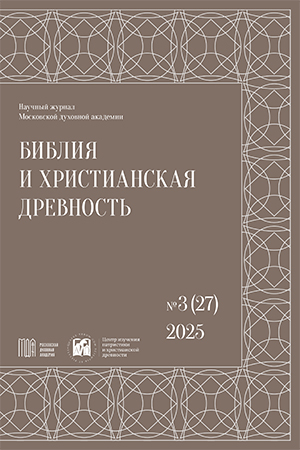
“Bible and Christian Antiquity” — a journal created at the Department of Theology of the Moscow Theological Academy, represents one of the areas of scholarly activity of the Center for the Study of Patristics and Christian Antiquity. The publication is intended to include previously unpublished original texts in Ancient Greek, Latin, and Eastern languages, as well as translations, commentaries, studies, reviews, surveys, chronicles of events and scholarly publications, and annotated bibliographies (thematic or by author) of monographs and journals on biblical studies, patristics, and the history of Christianity in the East and West.
The main aims and objectives of the journal are to present new scholarly materials on research and translations, reviews of publications by Russian and Western scholars, and to acquaint Russian-speaking readers with issues and publications in foreign languages.
Current issue
CRITICAL EDITIONS, TRANSLATIONS AND COMMENTS
This article offers the first publication in a series accompanying the dissertation research of Alexander V. Tamrazov (PhD candidate at the Gorky Institute of World Literature of the Russian Academy of Sciences) entitled “The Harmonious Texture of John Bar Zoʿbi in the Context of East Syriac Letters of the Late Abbasid Period”. The series is devoted to a hitherto unpublished fundamental East Syriac dogmatic-polemical compendium in verse, whose full title is The Harmonious Texture—on the Orthodox Faith Professed by the Catholic Church, Confirmed by Examples from the Holy Scriptures. The article presents the first results of codicological research, a translation of the compendium’s synoptic table of contents, as well as the Syriac text and Russian translation of the first six chapters of the treatise. New autobiographical data from chapters II–III are supplemented by a number of verses from the final chapter LXX, on the basis of which important clarifications are made concerning the life circumstances of John Bar Zoʿbi who turns out to have come from a Syro-Jacobite milieu and converted to the Church of the East at a mature age.
The newly translated chapters from the book of the prophet Isaiah contain apocalyptic and soteriological predictions, and also stories about the unsuccessful siege of Jerusalem by the Assyrians, the illness of King Hezekiah, his healing, the arrival of Babylonian ambassadors to him, to whom he showed his treasures, and the subsequent new revelation, by which the final of the era of one of the most pious Jewish kings was overshadowed. The content of chapters Isaiah 36–39 intersects with the chapters of the historical (in the Jewish classification, also prophetic) books 2 Kgs. 18–20 and 2 Chr. 32.
RESEARCHES. Eastern Christianity
This article examines the dogmatic teaching (Trinitarian doctrine and Christology) contained in the main work of Gerasimus, abbot of the monastery of St. Simeon the Stylite located about twenty kilometers from Antioch, The Complete Book of Healing Meaning (Apology). The theology of Gerasimus (13th century) is of interest because he was essentially the last significant medieval Orthodox author in Arabic, and thus his work can be seen as a kind of summary of five hundred years of Melkite theological and apologetic thought. Although the Apology presents dogmatic teaching rather fragmentarily, it allows for a general assessment of Gerasimus’s theology. In both Trinitarian doctrine and Christology, Gerasimus emerges as a typical representative of the Melkite tradition. His terminology is characterized by clarity and a limited use of theological terms, which distinguishes Gerasimus from many Melkite authors. In his Trinitarian teaching, he continues the tradition of Trinitarian theology, derived from the Cappadocian fathers, based on the premise of the complete actualization of the general in the particular. He is completely alien to both the concept of particular substances and the attributive Trinitarian doctrine that became widespread among Melkite theologians in the 10th–13th centuries. Gerasimus’s diphysite Christology, like that of many Melkites, is characterized by an emphasis on the hypostatic identity of Christ and the Son of God before the Incarnation. Gerasimus’s primary patristic source, both in his anti-Muslim apologetics and in his dogmatic teaching, is the writings of Theodore Abu Qurrah, the founder of the Melkite theological tradition. This does not preclude the author of the Apology from being familiar with the works of at least some Greek-speaking Church Fathers. The Complete Book of Healing Meaning provides grounds for considering Gerasimus one of the most significant Melkite apologists and theologians.
RESEARCHES. Eastern Christianity
This article examines the exegetical method of St. Jerome of Stridon through his interpretation of the Parable of the Workers in the Vineyard (Mt. 20:1–16) from his Commentary on the Gospel of Matthew (398 AD) as a paradigmatic model of patristic reception. The study analyzes a two-level hermeneutical scheme: tropological interpretation (correlating the “hours” with ages of human life) and historical-typological interpretation (periodization of sacred history from Adam to the apostles). Through detailed comparison of parallel texts, the creative transformation of Origen’s Alexandrian exegesis and its synthesis with the Latin tradition (Fortunatianus of Aquileia, St. Hilary of Poitiers, St. Ambrose of Milan) is demonstrated. Special attention is given to the opposition between works of the Law and evangelical grace, the theme of envy ( invidia ), and the interpretation of the denarius as the restoration of the image of God. The influence of St. Jerome’s commentary on subsequent Western tradition is traced through analysis of its reception by St. Augustine, St. Gregory the Great, and Carolingian exegetes (Rabanus Maurus, Paschasius Radbertus, Christian of Stavelot). Three models of patristic heritage assimilation are identified: compilative-didactic, creative-transformative, and adaptive-pastoral. The study demonstrates that St. Jerome’s exegetical synthesis became the “authoritative paradigm” of Western biblical studies, defining the hermeneutical tradition for centuries to come.
RESEARCHES. Patristics
This article examines the teachings of St. Gregory Palamas and St. Isaac the Syrian on the vision of the uncreated Divine light and considers the fundamental paradox in Palamas’ theology concerning the ability of a created being to perceive the uncreated. It also provides a detailed analysis of St. Isaac’s doctrine of the “spiritual sense” ( madʕā ) as an organ for perceiving the Divine, which is closely linked to his tripartite anthropology (body, soul, spirit). The research is based on a critical analysis of St. Gregory’s work The Triads in Defense of the Holy Hesychasts and three collections of St. Isaac’s writings, as well as on the consistent application of the findings from the study of St. Isaac’s terminological system, as developed in the monograph St. Isaac the Syrian on Hesychia and the Knowledge of God . A comparative analysis demonstrates that St. Isaac’s conceptual framework helps to clarify and resolve the apparent contradiction found in St. Gregory’s writings. Consequently, a unified picture of the knowledge of God emerges for both Church Fathersas a synergistic process in which the uncreated energy of God encounters the grace-transformed capacity of the human spirit to behold the uncreated light.
NOTES AND BIBLIOGRAPHIC REVIEW
This article presents a comparative analysis of the Christological doctrine concerning the divine dignity of the Son as articulated by the Apostle Paul in the Epistle to the Colossians and by the Apostle John in the Prologue to the Gospel of John. In expressing the divinity of Jesus Christ, the Apostle Paul refers to Him as the “image of God” (εἰκὼν τοῦ θεοῦ). The same idea is conveyed in the Gospel of John through different terminology, where Jesus is identified as the “Word” (λόγος), who is equated with God. Both apostles describe the attributes of Christ’s divine nature, placing particular emphasis on His eternal generation. To express this concept, the Apostle Paul employs the term “firstborn” (πρωτότοκος), while the Evangelist John emphasizes the Son’s eternal existence through the designation “Only-Begotten Son” (μονογενὴς υἱός) of God. Both texts further affirm Christ’s participation in the creation of all things. On the basis of an analysis and synthesis of the Christological doctrines of Paul and John, it may be concluded that the formation of the dogmatic teaching concerning the divine dignity of the Son, as well as the development of its theological terminology, began already in the apostolic period. A comparison of the Christological doctrines of the two apostles demonstrates that the divine dignity of the Son is expressed more precisely and explicitly in the Prologue to the Gospel of John.
NEW BOOKS
REVIEWS
CHRONICLE OF SCIENTIFIC EVENTS AND CONFERENCES

ISSN 2713-1122 (Online)